

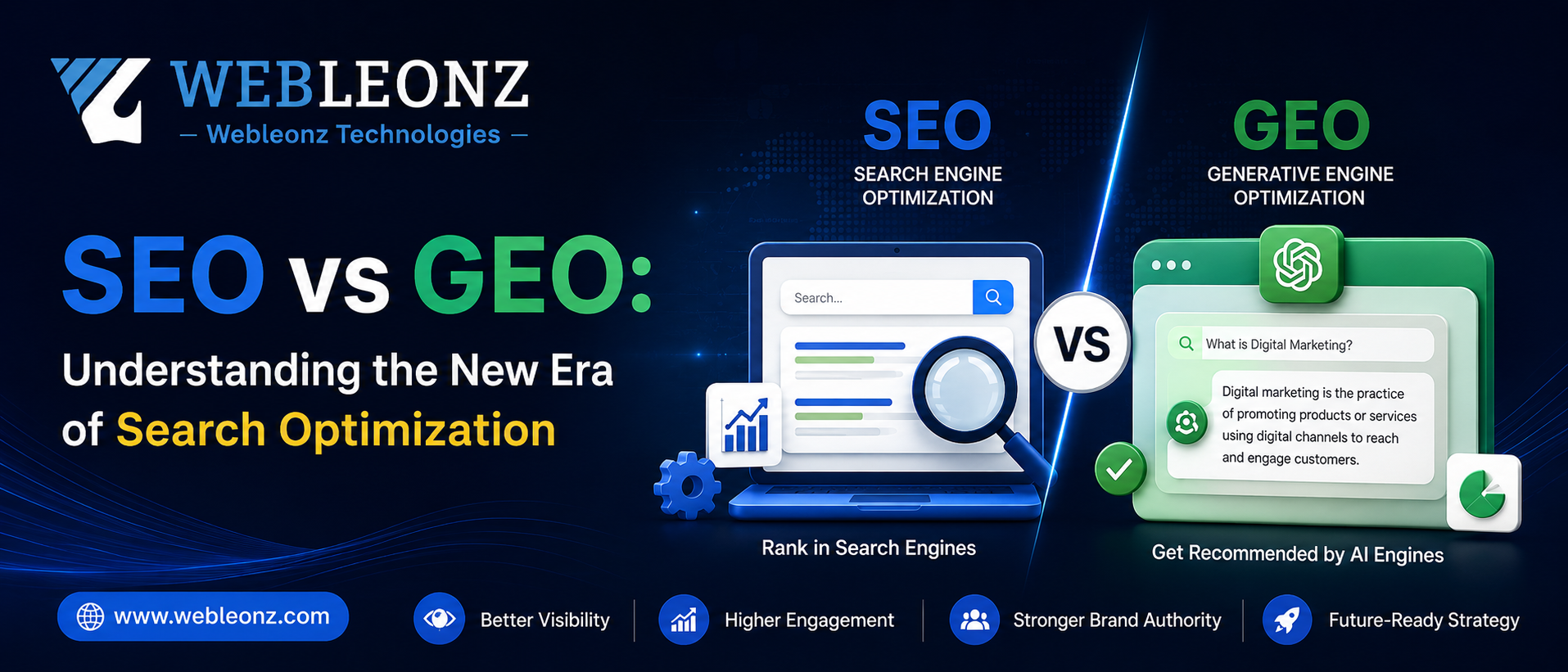
The online marketing world is changing quickly, and businesses are no longer able to rely on just search engine optimization. For the last several years, SEO has been considered king of online presence. However, with the advent of AI-powered search engines and generative search technologies, a new paradigm known as GEO has emerged. Knowing the difference between SEO and GEO will be critical for businesses to continue to compete in the modern search environment.
What Is SEO?
Search Engine Optimization (SEO) refers to techniques for increasing a website’s visibility to typical search engines like Google and Bing. SEO specifically targets factors such as content, technical, backlinking, page experience, and relevancy to enhance rankings within a SERP.
By employing a sound SEO strategy, businesses will bring the right traffic and lead generation and enhance their brand awareness. When implementing SEO services in Colorado businesses, the focus is on content, user page experience, and search intent.
What Is GEO?
The approach that most new developments related to AI-powered search use is referred to as Generative Engine Optimization (GEO). The difference between traditional rankings and generative engines is that generative engines use AI to answer searches directly for you, providing a synthesized summary or recommendation.
Any platform driven by a large language model will be able to gather information from a variety of places to synthesize a direct answer. GEO looks at ensuring a brand’s content is well-structured and a good source of truth that an AI could use to form its answers.
We will begin to need to be optimized not just for ranking but also for being pulled into AI-driven search answers.
Key Differences between SEO and GEO
While SEO and GEO share the goal of increasing online visibility, their methods differ significantly.
- Ranking vs. Referencing
Traditional SEO aims to secure top positions on search engine results pages. GEO focuses on becoming a trusted source that AI systems reference when generating answers.
- Keywords vs. Context
SEO relies heavily on keyword optimization and search intent. GEO places greater emphasis on contextual relevance, semantic relationships, and comprehensive topic coverage.
- Clicks vs. Visibility
SEO success is often measured through clicks, traffic, and conversions. GEO success may involve brand mentions, citations, and inclusion within AI-generated responses, even when users do not click through to a website.
- Search Engines vs. AI Engines
SEO primarily targets Google, Bing, and other search engines. GEO targets AI-powered assistants, conversational search tools, and generative search platforms that provide direct answers.
Why GEO Matters in 2026
The world of search is transforming rapidly, and AI is at the center of it all. AI-driven search experiences are going to be prevalent in how users find products, services, and information.
Consumers are looking for quick, concrete answers and will move past lists of links. GEO businesses will be lost and missing from this growing number of generative search experiences if they ignore GEO.
Content creation, showcasing authority, and presenting clearly and concisely are what brands can do to be featured in generative searches.
How Businesses Can Combine SEO and GEO
So what’s next in the world of digital marketing: SEO or GEO? The answer is neither – and both. Successful companies will embrace a mix of both SEO and GEO to optimize visibility both in a conventional and AI search environment.
Utilizing these strategies can produce effective results, such as the following:
- Content Written by Experts and Deep Information
- Structured data and markup schema
- Topical authority for the niches that comprise your industry
- factually correct data
- Website speed and user experience.
When it comes to search marketing, an SEO and GEO combination is really potent to get businesses establish a presence and be ready for the future of search.
Conclusion
As search evolves, the way in which companies conduct online visibility must also adapt. SEO will continue to be the backbone of all digital marketing efforts, but GEO opens the doors to a new way to drive traffic through AI-driven search experiences. Companies which embrace both approaches will win the opportunity to capture traffic, build domain authority, and adapt to the latest trends. Companies that adapt to this new search optimisation frontier and leverage the power of Webleonz technologies will be well positioned for sustainable competitive advantage in an AI-driven future.